Monday, September 30, 2024

Sermon: Cutting things off for life (September 29, 2024)

Pentecost 19B
Sept. 29, 2024
Mark 9:38-50

INTRODUCTION

In two of our texts this week, Numbers and Mark, we get stories about one group of people judging another because they don’t act or believe the right way. That’s nothing we know anything about, right? Haha, right! We are all too familiar with having strong feelings about how something should be done, and who should be doing it, just like the Israelites and the disciples. These texts show us that, as Jesus says, “Whoever is not against us is for us.” We all want the same thing and have the same goal, so have some grace for one another along the way. James will show us what the Church could look like instead – praying for the suffering, celebrating with the joyful, confessing when you’ve done wrong. It’s all so simple to say, but difficult to do when our pride and deeply held convictions are at stake! 

As you listen today, think about the ways you have, even with good intentions, tried to bring others down a notch, or tried to get them to see things your way (that is, of course, the right way), or accused them of something before recognizing the behavior also in yourself. We have all done these things. Notice how humans have done them all along, and what God has to say about it. Let’s listen.

[READ]

May the words of my mouth and the mediations of our hearts be acceptable to you, O God, our Strength and our Redeemer. Amen.


A couple of weeks ago, we had the first of our series of monthly evening prayer services this fall. The idea with this series, every 3rd Thursday, is that we come together mid-week, to escape from the relentless demands of life, and connect with God and with one another, first through communal prayer, and then over a simple meal and guided conversation on a meaningful topic. For the first gathering, the topic I settled on was: anger. Specifically, how do we speak to one another in love, even when we feel angry?

I decided to start there partly because I have been doing a lot of work in the past years on my own anger. I am not an outwardly angry person, generally speaking. My default, rather, is to bottle it up, making it into a simmering resentment, until one day someone throws some salt on it, and I boil over and explode. Sounds super fun, right? But of course, I don’t want to be that way. And so, I have been working on learning to identify when I feel angry, notice what triggers it, and how it feels in my body, so that I can express it more peacefully before it gets to the boiling point. 

That effort is what I thought of when I read this last line of our Gospel reading: Be at peace with one another. Easier said than done sometimes, right? Because some people are just infuriating. Some people make it really difficult to be kind and peaceful. Some people make us feel like yelling, because they need to be put in their place. Some people! 

Of course, the truth is… you and I are “some people” as well. We are all the “some people” who make it difficult to “be at peace with one another” for someone. Sometimes, we are the problem. 

Jesus points this out to us, albeit in language that can be difficult to take in. “If you cause someone to stumble in faith, tie a big rock around your neck and be thrown into the sea. That would be better for everyone. If your hand or leg or eye causes you to sin, cut them off and burn ‘em up. That would be better than burning in hell with both eyes and hands and legs.” Oof. Makes me wonder if Jesus maybe never took a class in pastoral care, ya know? 

Now let me just get this out there right away: Jesus is using hyperbole here. He is not literally advocating we cut off our own limbs or drown ourselves – nothing else he says could be used to support that interpretation. The exaggeration here is SO great as to make it obvious he is using these extremes to make a point. So you can unclutch your pearls and put down your smelling salts. 

But. Just because it is not meant to be taken literally does not mean it shouldn’t be taken seriously. It is shocking, yes, but shocking for a purpose, and that purpose is this: to understand the dangers of sin, and the ways it is affecting our relationships with God and neighbor, and how we act out our faith in the world.

For example, thinking about my anger example from before: I spent a lot of years (maybe you can relate) blaming my anger on other people who were making me mad by, say, not keeping commitments, not making an effort, lacking compassion, lacking integrity, being dishonest – all things that rubbed against my core values. The anger I was keeping inside was poisoning my heart, making it hard to view “those people” with the compassion and love with which Jesus views me, for instance, a first-rate sinner. And when the anger finally exploded, I said hurtful things to people I cared about. I found that my anger at people sinning against me or someone else, was turning me into the very kind of sinner I despised, someone lacking compassion, saying things I didn’t mean, not keeping my own integrity, etc. And living in that reality, in turn, caused me to hurt, to suffer.

Enter Jesus: “If your… anger… causes you to sin, cut it off. It is better for you to enter life without that defense mechanism, that self-protection, that mode of operation, then to keep holding it close to you and suffering as a result for the rest of your life.” We all have certain reactions, inclinations, or habits that have become our default, and we have told ourselves, even since childhood, that we need them in order to get something we need (safety, love, whatever). But what worked for us as children, is no longer serving us; indeed it is causing us to sin. Maybe these patterns have become so much a part of us that they feel like a body part. And when they get cut off, well, that can feel very much like losing a part of us! And there is an adjustment period. Without that leg, now we may stumble a little while we walk, as we figure out how to replace that old habit with a new, healthier one. Without that arm, we have to operate differently in the world. Without that eye, we can’t always see as clearly at first which way to go. 

I have a dear friend who has done a lot of work trying to understand his mental illness, and the unhealthy ways he has learned over time to deal with it. As he pulls back the layers, he said, he finds it is difficult to know how to replace his old unhealthy patterns with new, healthy ones. “I always did [this thing] because it made me feel safe,” he said. “And now I feel vulnerable without it, but I’m not yet sure what to do in its place, or if I even need something in its place. Everything is different, and it’s scary and unsettling.” Yeah, it is! This sermon of Jesus’ is scary and unsettling, because it calls for us to take a deep look at what is our way of operating in the world – even patterns we developed as children or young adults to get what we needed – and discern whether they are now in fact causing us to sin, whether they are causing a rift between us and the closer relationship with God and our neighbor that we crave. 

Maybe your issue is also anger. Lord knows, it’s hard not to be angry at something or someone these days, isn’t it? Or maybe it is apathy, or a tendency to withdraw from the world or your loved ones when they express emotions you don’t know what to do with. Maybe it’s addiction, or perfectionism, or a need to be needed, or to be affirmed by others. Maybe it’s always running away from pain, rather than facing it and dealing with it. There are so many stumbling blocks that would keep us from the life-giving relationships that would fill us and inspire us, so many tripping hazards that would keep us from being the people God calls us to be. 

The work to cut those things off is indeed work. But the payoff is great. When we can do this, Jesus says, we can “be at peace with one another.” Doesn’t that sound great, in this current climate, in which everyone has an opinion about how other people should act or speak or vote? I have heard people say, “You can’t be a Christian and vote for a Democrat,” and I have heard, “You can’t be a Christian and vote for a Republican.” The other person is always doing it wrong, right? If it’s not my way, it’s the wrong way! That’s what we see even in the Gospel, and in the Numbers text. “Some people over there are doing a thing, and trying to accomplish the same thing we are, but they are not doing it the same way we are.” That sort of thinking has been around a long time. 

But what does Jesus say? “If they aren’t against us, they are for us.” If they aren’t putting stumbling blocks in our way, tripping us up, then let them do what is needed to bring about the kingdom of God on earth. If they support a policy you think is terrible, but they are spending their weekends volunteering at the homeless shelter, celebrate that. If they are voting for the wrong person, but they donate thousands of dollars to help vulnerable people, celebrate that! Find values that we share, and even if we have different ideas of how to get to our shared goal, recognize that we at least care about the same things, and find and celebrate the ways we can work together toward our shared kingdom goals. 

This is all so hard, friends. I know that I am not alone in my frustration and discouragement about the division and demonizing and unwillingness to open eyes and hearts to listen to another perspective. I know I am frustrated with my own struggle in doing that! And I’m worried about the high stakes of it all. I certainly don’t want to make light of those real experiences. I believe there is a time and a place for prophetic speech, and righteous anger, and calling an evil what it is, though I still think these tasks can be done with love and compassion for the one who differs from us. 

But what I think Jesus is saying here is that we are in no place to be tattling on how someone else is “doing it wrong,” until we have done the work, with the help of God’s convicting Word and loving presence, of determining and cutting off our own offending limbs. This will show us the way toward the eternal life that Jesus is offering to us, a life of being at peace with one another, and of being freed from sin and death, of being in an intimate and fulfilling relationship with the God of life.

Let us pray… Compassionate God, you call us to be at peace with one another, but that is really, really hard sometimes. Soften our hearts, so that we can both see what in us needs to change, and also see the one who differs from us as another beloved sinner of your flock, just like we are. In the name if the Father and the Son and the Holy Spirit, Amen.


Monday, September 16, 2024

Sermon: Who do you say that I am? (Sept. 15, 2024)

Pentecost 17B
September 15, 2024
Mark 8:27-38

INTRODUCTION

Isaiah begins today’s reading with, “The Lord has given me the tongue of a teacher, that I may know how to sustain the weary with a word.” But I might call today’s readings more wearying than sustaining. Isaiah goes on to describe what is known as “the suffering servant,” a description some Christians believe foretells Jesus and his ministry. James has some tough words for us about the dangers of an unbridled tongue – something that should hit where it hurts anyone who has ever said something that has hurt or caused harm, or that they later regret.

But the most difficult reading comes from Mark, in which Jesus will ask his disciples that famous question, “Who do you say that I am?” Peter will give an answer that’s partly right, but from there, Jesus will fill in what he missed – about his need to suffer and die – and well, that doesn’t go as well for Peter. Turns out the life of discipleship might be tougher and require less obvious victory and domination than the disciples first imagined. This conversation happens in a significant location, as well, which I’ll get into in my sermon – but for now you should know that Caesarea Philippi is a city that oozes Roman imperialism. And for Peter to call Jesus the Messiah in this place is an overtly political statement, that expresses a hope that Jesus will overturn this government and reinstate the throne of David. So: you might say, this is tense.

As you listen today, think about the question that Jesus poses: who do you say that Jesus is? Who do you want him to be, and how does he actually show up for you? Let’s listen.

[READ]


Grace to you and peace from God our Father and our Lord Jesus Christ. Amen.

When I was interviewing for placement for my first call out of seminary, those of us who were assigned to this region, region 7, had what we called “bishop speed dating.” In the course of one day, we interviewed with as many bishops from as many synods as time would allow, and then the bishops and their staff got together and placed all of us. No pressure, right? I interviewed with three synods, and looking back, the whole thing is now a blur except for one moment that stays with me. When I interviewed with the Upstate NY Synod, the bishop asked me, “Who is Jesus? I don’t want your seminary answer; I want an answer in everyday language that people in the pews would understand. Who is Jesus?” I don’t remember everything I said, but I do remember that by the end of my answer, several of us around the table (especially the then-bishop and myself) were in tears. 

This is a question that matters deeply. And as I’m sure you noticed, today’s text is where it comes from. The location of this conversation is everything: they are walking into Caesarea Philippi. You see, this was a very politically charged place. Once a place of great significance to the Israelites, it was now occupied by the Romans. It is the epitome of Roman imperialism. When King Philip gained power in 4 BC, he named the place “Caesarea” to flatter his patron, Caesar Augustus, and Philippi to acknowledge himself (so basically, Philip’s Caesarville). Caesar Augustus, by the way, had given himself another title: divi fillius, son of the divine. He liked this self-appointed title so much that he had it engraved on the coin that bore his image: “Caesar Augustus, son of God.”

And now here, in this place of idolatry and imperialism, this place named for the Roman oppressor’s hero, Jesus asks the disciples, “Who do you say that I am?” And Peter gives a shocking answer: “You are the Messiah.”

Now, today we might not feel the full impact of this. Yes of course he’s the Messiah, we think. For some of us, it has rolled off our tongues since childhood. Jesus Christ, Jesus the Messiah, Jesus the anointed one. But this was an incredibly loaded title. You see, in the ancient world, among the Jews were those who were waiting expectantly for the Messiah to come – a messiah, who would be a great deliverer! It was generally thought this messiah, this anointed one, would be a king, who would come with military might, to deliver the people from bondage – at this particular time, someone who would liberate Israel from Roman occupation. This king would come in glory as a military conqueror, and restore the throne to the rightful line of King David (who was also called the anointed one, by the way, the messiah, and was a military conqueror under whom Israel was at its strongest). 

Based on what happens after Peter’s declaration, it was very likely that this violent, glorious vision of the Messiah was what Peter had in mind when he called Jesus by that name. He was expressing his deep hope that Jesus was there to restore the Davidic line, to deliver them, to liberate them from Roman oppression – and even, to use military might to do it. 

But Jesus has something else in mind. Jesus does not intend, as Peter expected, to lead them marching into Caesarea Philippi as weapon-bearing conquerors. In fact, Jesus says, it would be the opposite of that. He chooses this moment to introduce his most difficult and counter-intuitive teaching of all: that he, Jesus, must undergo suffering, be rejected, and be killed, and in three days rise again. This teaching is so important, that Jesus will repeat it in chapter 9, and once more in chapter 10. 

Imagine how Peter must feel, hearing this! This is not at all what Peter hoped for! How could Jesus be the conqueror, the winner, the restorer of Israel, if he was going to suffer and die? This was no Messiah, at least no Messiah that Peter was interested in getting behind.

Now, what would you do, if you had put all your hope in someone, in some specific outcome – indeed that you had dropped everything to pursue that hope – and you were told by that person that something very different would happen? If I really and truly believed in that thing, I would stay and fight for it. “No, no,” I’d say. “That isn’t right. That is not how this is supposed to go! Listen, let me tell you how it really is.” And that is just what Peter does. Mark tells us, that Peter took him aside (he didn’t want to embarrass his friend, I suspect!) and began to rebuke him. “Jesus,” I imagine him saying, “This is no good. If you’re the Messiah, you can’t be talking about suffering and dying. That’s not good messaging. No one will want to get behind that.” Really, it was the kind thing to do, the thing that could save the mission, and keep people from turning away.

But Jesus flips the script, rebuking Peter instead. “No, Pete,” he responds. “No, you need to get behind me, get behind this message. You are trying to push me in the opposite direction of the way I now must travel. Get out of my way, and get behind me. This is the way we are going.”

And then Jesus calls them all together – because everyone needs to hear this next part. And there, within view of that temple of empire and domination, Caesarea Philippi, Jesus describes his vision. “If you’re here for a violent campaign,” he says, “if you’re here for domination or triumph, then you can turn back now. That’s not who I am, or what I’m about. We’re not here in this place to conquer this temple. We are heading all the way to Jerusalem, and then on, to conquer the cross, that weapon of imperial terror. From the cross, we’ll head to the tomb, but then into new life, and then beyond that into a new community that is characterized not by violence and domination, but by love, gentleness, and justice. This is not a movement based on self-centered grasping for power; that is the way of Caesar. My way, is to let go of all that, to give it up, for the sake of the gospel of love and justice. We are not going to seek out suffering, but we must be willing to endure it, to take up the cross, because suffering is often along the way toward this radical gospel of love. Violence and attack are the easy way. Love, is the way of life.”

“If you want to come,” Jesus goes on, “then take up your cross and come on. Let’s move together toward justice and love and humility and kindness and compassion – those things that may seem weak or fragile but are stronger and more impactful than anything the empire has to offer. They are things that can heal this hurting world. But have no illusions. This will not be a triumphant march. Like all movements of love, kindness, and justice, there will be suffering along the way. There will be crosses to bear. But far more than that, there will be resurrection and new life. So take up your cross, and follow me.”

The Roman empire has long since fallen. But the problem of empire is still very much a part of our reality. We are always faced with the choice to choose love over fear, and justice over complacency, and compassion over anger. We always have the choice to seek domination and self-serving, or, building each other up. We can approach life with hands clenched into fists, ready to cling to our own way, or punch down someone else, or we can open our hands in generosity and strength – and be ready to faithfully and gratefully receive the gifts of God.

We all want to be saved from something, just like Peter. But rather than grasp for power, let’s “lose our lives,” as Jesus says, and focus instead on turning toward our neighbor, even toward our enemies, in love and generosity, knowing that we will no doubt encounter suffering, but we’ll encounter resurrection and new life, all the more.

Let us pray… Jesus Messiah, we often crave power, crave winning. But yours is a way of compassion, humility and love. Give us the courage to follow your way. Sustain us when we suffer for the cause of love. And open our fisted hands so we are ready to serve one another, and receive your mercy. In the name of the Father and the Son and the Holy Spirit. Amen. 


Monday, September 9, 2024

Sermon: Being opened (Sept. 8, 2024)

Pentecost 16B
September 8, 2024 – Rally Day
Isaiah 35:4-7a; James 2:1-17; Mark 7:24-37

INTRODUCTION

In my page in the St. Paul’s newsletter that went out last week, I printed the core values that came out of the visioning work we’ve been doing the past several months. They are also on the back of your bulletin –I’d love to hear your response! One of the values that we considered aspirational (meaning, we do it kind of, but would like to grow in this area) was the one around welcome and inclusivity. 

So I was delighted when I read the readings for today, traditionally the first Sunday of the new church program year, and I saw throughout, this theme of openness and inclusivity, showing no partiality, reaching beyond natural and cultural barriers. What a great set up for our year! We’ll see this explicitly in the words of James. Isaiah and the Psalm talk about opening the eyes of the blind and the ears of the deaf, and generally eliminating anything that would keep us from being together in relationship with God. 

We also see it in Mark, as Jesus ventures into Gentile territory. Gentiles are people outside of the Jewish community. In Mark’s Gospel, Jesus often takes great effort to venture into these non-Jewish areas, these places populated by those who are “other” to, or even, in some cases, enemies of the Jewish people. So today he takes a journey to Tyre, a place far from his home in Galilee, where he encounters a Syrophoenician woman (so, she is Greek, and descended from people of Syria, and Phoenicia, two historic enemies of Jews). His encounter with this woman changes, or rather, opens up the scope of his ministry, and he continues onto another largely Gentile (non-Jewish) region to continue his ministry with this whole new segment of society. So, today’s story is an important turning point in Jesus’ ministry, from focusing on Jewish people, to opening his mission up to non-Jews.

All of these readings are full of life-giving words for those desperately in need of that news… even as they are challenging words for those of us accustomed to feeling comfortable in our faith and our lives. Notice how they make you feel. Let’s listen.

[READ]


Grace to you and peace from God our Father and our Lord Jesus Christ. Amen.

Is it just me, or does Jesus seem a little… off, in today’s Gospel reading? I mean, we usually picture him as the very embodiment of compassion, care, and availability, right, but today, he first enters a town and doesn’t want anyone to know it, wants to hide away for a while. And then, when someone comes to him for help, what does he do but insult her! “Can’t help you now,” he says. “Gotta help the children of Israel first. I’m not gonna throw their portion to the dogs!” Did he just… did he just call this woman a dog, and refuse to help her daughter? What?? This is not the Jesus we know and love!

It is one of the more puzzling interactions Jesus has, for sure. Interpreters have spilled much ink trying to figure this one out. Is this just an example of how Mark paints a much more human picture of Jesus? Throughout the Gospel of Mark, we see Jesus exhibit more emotions, as well as more human frailty, even lack of knowledge at times, than we do in the other Gospels. So maybe Mark is saying that Jesus was tired, and a little bit irritable, snarky, and dismissive? I mean, we get that, right? We’ve all been there! But… does Jesus get snarky and dismissive? It opens a complex theological can of worms.

Or maybe, is Jesus testing the woman’s faith? Yeah, standing as the wise teacher who is seeing how bold she will be in her declaration, always with the intention of giving her what she asks, and letting her win the argument. That seems to fit better with our understanding of Jesus – even though I don’t especially like the idea of a God who tests our faith for sport, while our loved one lies in pain!

It’s a tricky one, and it can be very easy to get caught in the weeds of this question – I know I have spent a fair amount of time there. 

But in the end, that’s not the point of the story, and not what really matters to me. What matters more than why Jesus responded to this woman the way he did, is that the woman, who is an ethnic, religious, social “other” from Jesus, has the opportunity to proclaim, even to us, the truth: that Jesus is there for her, too. That her life, and the life of her daughter, matter, and should matter even to this Jewish teacher, even to this God. That she is worthy of God’s care, compassion, and love. This woman boldly proclaims that truth.

We have a complicated relationship with the truth these days, don’t we? There has always been a fair amount of fuzziness around the truth in politics, but it has gone off the rails in the past decade – well past a creative reframing of the facts, and fully into easily verifiable lies. That, along with evidence of foreign interference, and the rise of AI and easily altered visual media, and the result is that the folks trying to keep up at home just don’t know who or what can be trusted anymore. What really is the truth, and what is only some version of the truth, cherry-picked, or conveniently twisted or edited to support one viewpoint or disprove another? In the words of Pontius Pilate, “What is truth?”

Yet here, this woman of Syrophoenician origin, boldly proclaims a very important truth, and one that can absolutely be trusted: that she matters, and that her daughter matters, and that they are worthy of God’s attention and care. 

But even when a truth, like this, is indisputable, that does not always mean it is easy to hear. Jesus seems to receive it readily enough, but for us? We sometimes have a hard time receiving the truth, especially when it rubs up in a bad way against something we believe and hold dear, when it challenges our viewpoint. Once we have decided what is the truth, I think a lot of us tend to close our minds and our hearts to anything that doesn’t fit with what we believe. 

Perhaps that is why I am particularly drawn to what Jesus says in his next interaction with a Gentile, the man who is deaf and mute. Jesus doesn’t just lay hands on this man to heal him. He says to him, “Be opened.” 

“Be opened.” This is message I know I need to hear, and one I think we could all stand to hear and take to heart. Be opened. Be opened to the movement of the Spirit. Be opened to learning something, even something that at first makes you uncomfortable. Be opened to the gifts of others, even others whom you don’t like. Be opened.

I remember once sitting in the office of my college band director. He was leaning back in his chair, with his arms crossed tightly across his chest, when he started to reflect, as he often did. He said, “You know, I’ve been told you should never sit this way, arms crossed, when talking to someone. My teacher used to say, ‘Closed body, closed mind.’ But I don’t know – I think I have an open mind, but I just think it is comfy to sit this way!” Well yeah, it is also comfy to sit in our opinions and never let them be challenged. It is also comfortable to stay right where we feel safe, and know how things work. It is comfortable not to rock the boat, not to speak up when we know something is wrong. But I wouldn’t say any of those things are necessarily open, nor faithful! (That said, I do think my band director had a pretty open mind, and was very faithful, despite his crossed arms!)

Be opened. Be opened to the truth, even uncomfortable truth. Be opened to ideas, even ideas you think would never work. Be opened to the possibility that you might be wrong, and someone else is right. Be opened to change, even if you love where and how things are. Be opened.

I think this is a valuable word for us today, on Rally Day, as we begin a new program year. We have some exciting things on the horizon. In the September newsletter, as I mentioned, I printed the core values that emerged out of the visioning process we’ve been working on. Some are values we already live into effectively, and some are aspirational, things we need to work on. In the coming two weeks, the Keymel committee and the council will start making some decisions about how we will spend the bequest we received earlier this year – keeping in mind how we can use this gift to help us better live into our values, including and especially the more aspirational ones. 

Some of what will happen in these next months is objectively exciting, and will be easily received. Some might require some risk. Some might require some patience, as we work through the inevitable tough spots. All of it requires for us to “be opened” – to listen to one another and our broader community, to be kind and responsive, to entertain the possibility of sitting in a position that might not be as comfortable at first, but one which will absolutely make us grow stronger in mission and in faith. 

All of what will happen in the coming months, I hope, will equip and empower us to boldly proclaim the truth: That ours is a God who loves, who cares, who heals, who brings life, both to those on the inside, and those who are “other,” who are different from us, like the Gentile woman and her daughter, and the deaf, mute man. That ours is a God who never promised that we would be comfortable, but rather, who always invites us to move, to change, and to grow. I hope we will be empowered to proclaim that ours is a God who listens to our needs, who equips us to boldly share our stories of how God has been active in our lives, and who bids that we “be opened” to the possibilities of new life that God places before us. 

And so let us “be opened,” my friends. As we enter into this new, exciting year of ministry, let us be opened and responsive to the ways that God will move within, among, and around us.

Let us pray... Active God, you make the eyes of the blind be opened, and the ears of the deaf unstopped. Make it so also with us, dear Lord. Make us bold to listen, to be opened, and to proclaim your truth. In the name of the Father and the Son and the Holy Spirit. Amen. 


Tuesday, August 27, 2024

Sermon: To whom shall we go? (August 25, 2024)

 Pentecost 14B
August 25, 2024
John 6:56-69

INTRODUCTION

Today’s texts all share a very prominent theme: that of faithfulness to the one true God, even in the midst of struggles and temptations. They are texts as convicting as they are encouraging. They fill me with hope in the power of faith, and with hopelessness at my inevitable failure always to keep that faith. In other words: they do exactly what the gospel, the living Word of God, sets out to do: comfort the afflicted, and afflict the comfortable.

In the reading from Joshua, Joshua asks the Israelites which god they will serve: Yahweh, or the various false idols they have in their possession. The people give an unequivocal “yes!” to Yahweh. In Ephesians, Paul talks about the devil and the forces of evil that are among us, working their woe, and how we must prepare to defend against them by putting on the armor of God. And in John, you remember we have just come to the end of Jesus’ long Bread of Life discourse. Anyone remember the difficult teaching Jesus offered them last week? The one about how they must eat his flesh and drink his blood in order to abide in him and have eternal life? It’s a difficult teaching all right, one which, as we’ll see, causes many to turn their backs on this compelling teacher. Yet when faced with the decision as to whether to leave Jesus’ side, Peter utters the words now memorialized in our Gospel acclamation: “Lord, to whom shall we go? You have the words of eternal life.” 

Faithfulness and commitment. It is a gift and a challenge as old as time. Let us feast upon these stories of faith, as we reflect also on our own journeys that have taken us to the edge of doubt, and back again. Let’s listen.

[READ]


Grace to you and peace from God our Father and our Lord Jesus Christ. Amen.

This week the kids and I were looking at a book of conversation-starters for families. One of the questions was, “If you could meet anyone in history, who would it be and why?” My immediate answer was, “Jesus, because I wanna see for myself. I wanna know what it was like to watch him in action.”

Well today we get a glimpse of what it was like. Often when Jesus says or does something stunning, the response is, “And they were all amazed!” Not so today. Today, the crowd’s first response is: “This teaching is difficult. Who can accept it?” That’s a very human reaction, isn’t it, especially in today’s world, in which we pride ourselves on our autonomy and good sense: we make our own decisions and believe what we want to believe and do what we want to do. So when we hear this difficult teaching from Jesus, it is natural to think: This is weird, it goes against my logic, I can’t accept it. I can’t understand it, so I will not abide by it. 

And it’s true, it is difficult. But you know… This is not the only of Jesus’ teachings that are difficult. Here are a few other difficult teachings that come to mind: 

• “Go, sell your possessions, and give the money to the poor…; then come, follow me.” Really? ALL of my possessions? But can’t I keep just these few things? They mean so much to me. Can’t I keep something for myself?

• “Then Peter came and said to him, ‘Lord, if another member of the church sins against me, how often should I forgive? As many as seven times?’ Jesus said to him, ‘Not seven times, but, I tell you, seventy-seven times.’” 77?? I sometimes have trouble with one! 77 is a lot, Jesus. What if what they did was really bad, or a repeated offense?

• “If anyone strikes you on the cheek, offer the other also.” Wait, I can’t fight back, not even with my words? But what if this person is a real jerk and needs to be set straight? Or what if turning the other cheek just encourages them to continue being mean and hurting others?

You see? Jesus’ teachings are difficult, no two ways about it. They often go against what our culture tells us to do, which makes them even harder. This one about the flesh and blood – it’s hard, too. But the fact is, living the life of a Christian, and walking the way of Christ, is difficult. There’s a wonderful Maya Angelou quote: “I’m trying to be a Christian,” she says. “I’m working at it, and I’m amazed when people walk up to me and say, ‘I’m a Christian.’ I think, Already? Wow!” This faith business is something we need to work at! It’s a process. And it’s difficult. Can we accept it?

Which brings us to the next part of the reaction to Jesus’ bread of life teaching. John tells us that “because of this [teaching], many of his disciples turned back and no longer went about with him.” We’re not talking some folks who just happened to be hanging around. These aren’t your Christmas and Easter Christians. These are Jesus’ disciples, people who had been following him, who had already invested something in him. They were folks who sat on council, who led Bible studies, who set up for coffee hour. And when asked, “Who can accept it?” they decided, “I can’t. This is too much.” And I expect that seeing these faithful people turn around and walk away would make it even harder for others, who might have stayed, to accept this teaching.

In my home synod in CA, we had a bishop some years back who, some time after his term as bishop, became an atheist. He no longer found he had any faith at all. When he died, at his funeral, there was no mention of the resurrection, no word of Christian hope. And that is hard, to see someone you looked up to as a model of faith (a bishop!), suddenly reject that faith. This teaching is difficult. If even Jesus’ disciples struggle to accept it, how can I?

         And then perhaps what is for me the toughest reaction of all: when Jesus turns to the twelve, those followers who were closest to him, and asks them, “Do you also wish to go away?” Whether this was asked as a challenge, or out of sadness, or simply out of fatigue and discouragement, this is the question that gets in my craw. “Do you also wish to go away?” Sometimes I feel like it is directed right at me. This teaching is difficult, Johanna. Do you wish to go away? This life is a hard one to live, Johanna. Wouldn’t it be easier just to go away? How does your faith understand this tragic event, or this difficult time, Johanna? Do you wish to go away?

         Sometimes… the answer is yes. That would be easier, I think, easier than upholding all these difficult teachings. Easier than seeing the evil, brokenness, and sadness in this world and trying to understand it through the lens of what is supposed to be a God of love. Easier than trying to be true to my Christian beliefs in the context of an increasingly pluralistic society. …Do you also sometimes wish to go away?

         When I had just begun my year serving as a missionary in Slovakia, I learned of a horrific tragedy back home, something that shook my very foundations and caused me to lose faith in the God who I believed had called me to Slovakia in the first place. I had already been on somewhat shaky ground with my faith, because the month and a half I had been in Slovakia had not gone very smoothly, but now, this event, made me doubt the existence of God at all – how could a God of love allow this to happen? For days, I lived in fear and darkness. I was scared of everything, and I lived in a fog where nothing could turn my mourning into dancing. In those days, I did wish to go away. Having faith in this God – it was too difficult for me. I could not accept it.

         But then, after experiencing this darkness, after living several days in fear, I had a moment like Peter had in response to Jesus’ question. “Lord, to whom shall we go?” Peter asks. “You have the words of eternal life.” Where else can we possibly go? That October in Slovakia, I, too, was faced with these two possibilities: continue to reject a God who had let something horrible happen to someone I loved, and with that continue to live in darkness; or, cling to the hope that is promised through the resurrection, as difficult to accept as that may be in that moment. And my answer was the same as Peter’s: “What else am I supposed to do? Where else can I go?” Angry, disappointed, and hurting as I was in that moment, I couldn’t imagine living without this God. Without Christ, there are no words of eternal life. There is no hope. Lord, to whom shall we go? Difficult as following you may be, you have the words of eternal life that offer me hope in the midst of my despair.

The teaching is difficult. It can be hard to accept it. It can be even harder to live it, to receive, through no merit of our own, God’s immense grace and love, the forgiveness of sins, the promise of everlasting life… and then, having accepted and embraced that grace, to go out and actually live the life that Christ calls us to: a life that cares more about the poor, the immigrant, the lost and dejected, the broken, the weak, the morbidly obese, the drug-addicted, the imprisoned – to care about all of them at least as much as we do about ourselves. A life that shares the love of Christ with everyone we meet, even people we don’t like, or with whom we disagree, or who did something to hurt us, or who are just really annoying.

But here’s the good news: this teaching is difficult, but we’re not in this alone. Jesus promises us that. And we receive that promise every time we wake up in the morning, every time we splash water on our faces and remember we are baptized. We receive it every time we hear the words of eternal life, every time we are forgiven, and every time we come to this table and feast on the body and blood of Christ, where we receive the strength and nourishment we need to live this life Christ calls us to. This teaching is difficult, but to whom else could we possibly go?

Let us pray… Christ, our Bread of Life, following your teachings is difficult, and sometimes hard to accept. By your strength and patience, help us to follow you anyway, trusting that you do have the words of eternal life that can carry us through all things. In the name of the Father, and the Son, and the Holy Spirit. Amen.

Full service can be viewed HERE.

Monday, August 12, 2024

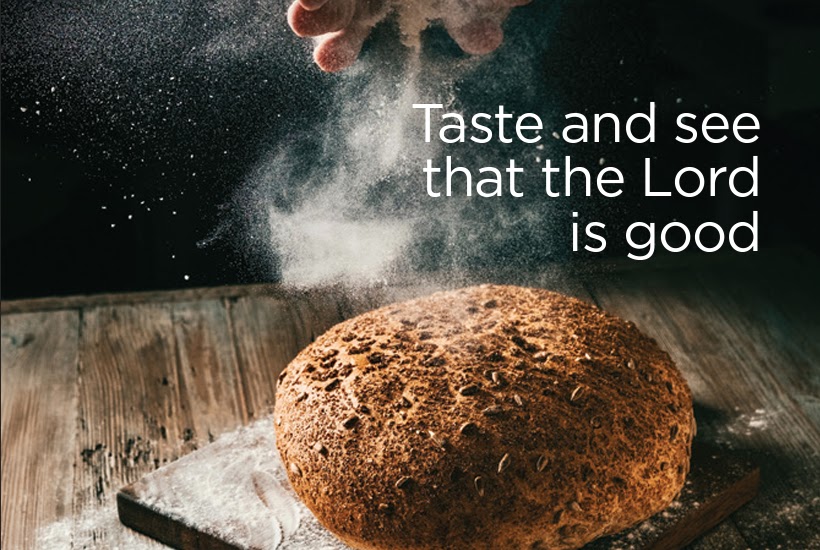
Sermon: Taste and see! (August 11, 2024)

Pentecost 11B
August 11, 2024 (week 3 of bread discourse)
1 Kings 19:4-8
Psalm 34:1-8
John 6:35, 41-51

INTRODUCTION

This is week three of the bread of life series, so let’s first recall where we are in this discourse. For these few weeks we are working through John 6, which begins with Jesus feeding 5000 people with five loaves and two fish, and continues with explaining what this sign means. Today we get into more of the theology of it, as the crowd continues to be dubious about what Jesus means by calling himself the bread of life.

The Old Testament story paired with this portion of the discourse is about the prophet Elijah, who is also fed miraculously in the wilderness. Here’s the context: Elijah has just killed a bunch of false prophets (prophets of Ba-al), and Queen Jezebel has consequently vowed to have him killed. He is running for his life, and at the beginning of today’s reading, he has just collapsed in exhaustion. And here, in this moment of exhaustion and hopelessness, God provides. The Psalm, which liturgically is always meant to be a reflection on the Old Testament reading, recalls how God meets us in our desolation and delivers us – just like with Elijah, just like with David who wrote this Psalm, and just like with us today.

As you listen to these readings, notice the words of life and sustenance spoken into feelings of despair. God does provide for us all that we need. Let’s listen. 

[READ]

Grace to you and peace from God our Father and our Lord Jesus Christ. Amen.

Twelve years ago this month, I was undergoing medical testing for what turned out to be breast cancer. I’d had test upon test, and each had led us to something else we needed to check out. In the midst of this mess, I decided I needed something that would bring me life and joy, so I suggested to my music director at the time that I could sing something in worship, in particular a beloved setting of today’s Psalm that I’d learned in seminary – the very same one that Helena will sing for us as the offertory today. The refrain goes, “Taste and see, taste and see, the goodness of the Lord!” I was excited to be able to use music to help me escape for a moment what I was going through.

Well, it seemed like a good idea. But turned out, it wasn’t much of an escape. As I rehearsed it with the music director, the impact of these words suddenly hit me in a way they never had before. “I will bless the Lord at all times, his praise shall always be on my lips… I called the Lord who answered me… from all my troubles I was set free…” As I sang, visions of doctor’s offices and MRI machines came to mind, but so did visions of my family and friends surrounding me, and congregation members who had rallied around me, and memories of boob jokes my doctors and I had enjoyed sharing back and forth, and my steadfast then-boyfriend by my side all along, accompanying me to appointments, and doing all he could to support me through this. “Taste and see the goodness of the Lord!” I sang… 

And friends, as I sang, I completely lost it. First the telltale voice wobble. Then the sound just stopped coming out. And then all the tears started. I stood there in the sanctuary openly weeping over the goodness of the Lord, and the already-and-not-yet of this Psalm in my life at that moment. The organist, herself a breast cancer survivor, and someone with whom I’d had a somewhat rocky relationship, stopped playing and came over to me, unsure what to do with this sobbing young pastor before her. And suddenly I was throwing my arms around her, and continuing to cry into her shoulder. In so many ways, this Psalm was “not-yet” for me. A couple weeks later, I would be officially diagnosed, and undergo surgery. And then another surgery. And then 6 months later, two days after my bridal shower, cancer would show up again and I would have three more surgeries before all was said and done. Plenty of other health and personal challenges would come up along the way as well. So how could I stand there and sing, “Taste and see the goodness of the Lord!”? How could I possibly “bless the Lord at all times,” even in this trying time that threatened to take so much from me? How could I proclaim that the Lord had saved me from all my troubles, when really, my troubles were all just beginning?

And yet… I believed it. I checked in with my heart in the midst of all this, wondering if these tears were sadness, fear, or joy, and I’ve thought about it many times since, and I determined that the tears were, well, all three of those, but definitely mostly joy! Even in that dark moment in my personal story, I truly could taste and see that the Lord is good. 

I guess it is no surprise, then, that not only is this Psalm connected to a narrative in my own life, but its original writing was also imbedded in a narrative. In particular, a part of (the future King) David’s story. You may know that David wrote many of the Psalms. This particular one was written after he was running for his life from a wrathful monarch (not unlike our buddy Elijah!). The jealous King Saul, the first king of Israel, wanted to kill him. Saul’s son and David’s dear friend Jonathan helped David escape Saul’s wrath, making Saul even madder. David had taken refuge among the Philistines, but, you may recall that after David had, as a child, slaughtered their hero, Goliath, he was not on great terms with the Philistines. So, for his own safety, David faked his own insanity, so that they wouldn’t recognize him or perceive him as a threat. (This is the stuff of daytime television!) And it worked! And in gratitude for his safety, David wrote this Psalm. 

My own experience, and this biblical backstory, can help us see this Psalm’s power to guide our piety and devotion. I invite you to walk with me through it.

The Psalm begins with this bold declaration: “I will bless the Lord at all times. His praise shall always be on my lips.” This sentiment is not so hard to grasp when things are going well, when you’ve already been saved. But how do we do that when we are still in the pit? Well, here’s the thing about the Psalms: sometimes they are reflections back – for David, that was the case. But some are reminders that direct us forward toward a faithful life, even when the burdens of this life would threaten to drag us down. That’s how I experienced it in my own story: not as a memory, but as a desire and a prayer: “I will bless the Lord at all times. His praise will be on my lips. God, I know you can make it so! I know you can bring me to that place! Help me to see reasons to praise, even from this current darkness!” 

To be clear, I’m not suggesting we engage in what is sometimes called “toxic positivity” – an insistence to spin everything into a positive light, no matter what. I’m a firm believer in the importance of expressing all the emotions, even and especially the less nice ones, because if we don’t, they will eventually come out sideways, harming us or people we love. Identifying and expressing those feelings is the only way to process them and move past them. But. There is still a way to praise, even in the midst of those less nice emotions. The Psalmist does not say, “Praise God for everything.” Rather, there is something for which to praise God in everything. In my story, on the cusp of a cancer diagnosis, I could praise God that I had landed in Rochester for my first call, with its excellent medical care. I could praise God for a good-humored doctor who kept me giggling and laughed at my jokes. I could praise God for the immense grace my congregation extended as I sorted out my health just one year into my ministry with them. God’s praise could always be on my lips and in my heart, even as I was facing a deadly disease.

Jumping ahead now to verse 4: “I sought the Lord, who answered me, and delivered me from all my terrors.” For David, this verse reads as a thanksgiving for a specific event from which he was saved. In my story, I had not yet been delivered from the particular terror I faced. But I had been before. So in my reading, my experience of this Psalm in my particular time and place, this verse served as an invitation to remember all the times that I had been delivered, all the times I had sought the Lord and he answered me. And friends, there are many! Many in my personal life, many in the lives of my close family and my ancestors, and many throughout the generations of faith, as far back as David and well beyond. This verse, in short, is a reminder that God is faithful. God answers when we call. God delivers us from troubles. That is God’s M.O., from the story of the Exodus, to Elijah being fed in the desert, to Jesus overcoming the grave, to our own redemption from our troubles. Not always in the way or timing we imagine, but ultimately, every time. We seek the Lord, who answers us, and delivers us from our terrors.

And finally verse 8: “Taste and see that the Lord is good.” In Hebrew, that word “taste” means, “try it and experience it yourself.” And so this, too, is an invitation, urging us to imagine for a moment that this is all true, that God does deliver, that God is good… try it for yourself, and live into that reality. Truly believe it and believe in it. What freedom that faith and trust bring!

I have another poignant memory of this Psalm. It is from my grandfather’s funeral. My mom’s family has a wonderful store of German canons that they sing together, that they learned when they lived and worked in war-torn Germany in the 40s and 50s. They still love to sing them whenever they’re together. My favorite is based on this Psalm: “Ich will den Herrn loben alle zeit. Sein Lob soll immer darin meine Munde sein.” I will bless the Lord at all times, his praise shall always be in my mouth. We decided to sing that particular canon at the very end of Grandpa’s funeral, after the casket had been wheeled out but just before the postlude. We stood in the back and sang as a family, “I will bless the Lord always!” 

I admit that I thought at the time it was a weird choice. Yet, standing there, it was exactly right. We were praising the Lord, not for having lost my grandfather, but for the gift of his life, his long and fruitful years of ministry all over the world, and his love of the Lord. We were praising God for our certainty that Grandpa was now with his savior, basking in the light and life of Jesus like he had wanted all his life. 

And isn’t that exactly what a life of faith looks like? We do praise the Lord at all times, because we are assured that this joy is our ending: that political turmoil, and cancer, and loss and grief, and all the troubles that we face – all of it will end with us basking in Jesus’ enduring light and peace, living in the eternal life we are promised. And so, I will bless the Lord at all times. His praise shall always be on my lips.

Sing Ich will den Herrn loben…

Let us pray… God of all goodness, when we are lost, or sad, or in despair, you invite us to taste and see your goodness. Grant us the faith to bless you at all times, and to remember always your faithfulness. In the name of the Father and the Son and the Holy Spirit. Amen. 

View full service HERE (including several bits that were sung during the sermon...).


Monday, August 5, 2024

Sermon: Our vision through the lens of the bread of life (Aug. 4, 2024)

Pentecost 11B (week 2 of Bread of Life)
August 4, 2024
John 6:24-35

INTRODUCTION

Last week we began what is known as the Bread of Life discourse. Each of Jesus’ discourses in John’s Gospel are explanations of some sign, or miracle, he’s performed, so it’s important for our understanding that we recall what that sign was. Anyone remember what we heard last week? [Jesus feeding the 5000.] I’m sure you remember this story – Jesus and the disciples are all out, far away from town, and everyone gets hungry. One boy shares his lunch, and miraculously everyone ends up with plenty to eat, with 12 baskets left over. It is one of Jesus’ seven signs that we see in John’s Gospel.

The next part of the story happens the next day. Folks have gone to pretty great lengths to track down Jesus, and they find him, and today we will be hearing the beginning of the conversation that ensues. As always in John, conversation with Jesus is characterized by a lack of understanding, because Jesus is always talking from up here, in the heavenly realm, and people respond from down here, in the earthly realm. They totally miss what Jesus is really saying, because they are so stuck down in the world of the flesh. Not that we can really blame them. This is tough stuff Jesus is saying. Jesus is totally blowing their minds here. 

One more quick comment about our first reading: for Jesus’ disciples, this story of being fed in the wilderness has been the defining story about how God provides. It is so foundational, that it is what the crowd refers to in trying to understand who Jesus is. So listen carefully, and then hold onto that story as you listen to what Jesus says about being the bread of life. 

[READ]


Grace to you and peace from God our Father and our Lord Jesus Christ. Amen.

Our council has been working with our synod’s Director for Evangelical Mission, Pastor Imani Olear, to do some visioning work for our congregation. I wonder how many of you know our existing vision statement? It is to “spread the word of God, build a strong community, and make the world a better place.” As a part of this process, some St. Paul’s leaders have been working on our “Case Statement” – each of us taking a stab at thinking about questions like, “Who are we? Why does St. Paul’s exist? What is our vision for the future? Who does or will benefit from our vision, and how? Why does our community need our particular vision?” I love these kinds of questions, but they are really hard! This sort of introspection does not come easily to everyone. (I should add, by the way, that if you would like to take a stab at a case statement and answer any of these questions, you are encouraged to! They do need to be completed by this Thursday – if you want to do it, or just talk to me about it, let me know and I’ll make it happen.)

As I’ve worked on it, some of the questions have been straightforward, and some have left me feeling a bit like a deer-in-the-headlights (like, “Huh?”). When that happens, I find it helpful to look at questions like this through a particular lens – often, for me, a biblical one. So today I will walk us through looking at our vision statement, through the lens of our Gospel reading.

First: St. Paul’s has a vision to “spread the word of God.” Seen through the lens of the Bread of Life, we have an answer: we believe that the Word (in this case, the words of scripture, but also Jesus himself, the Word made flesh) nourishes us. And by that, I mean, the word of God sustains us, helps us to grow, to be healthy, to have energy for the task before us. The Word doesn’t perish, like breakfast does by lunchtime, but continually sustains us – and we gain more of these benefits when we regularly partake of it, in the form of scripture-based devotion, Bible study, prayer, worship, or whatever else feeds your spiritually. 

As far as our St. Paul’s vision goes, to spread the word of God – if we have a vision of spreading these benefits beyond ourselves, beyond even our congregation – then it goes to follow that we ought to be regularly partaking of it ourselves! How can we give away something we don’t have, after all? How can we share the joy of that vision with others, if we don’t intimately know that joy ourselves? 

As I worked on my case statement, and reflected upon how I see this vision playing out at St. Paul’s, I thought: my vision for St. Paul’s is that every member would, by consuming the Bread of Life with intention, be able to identify and articulate how God is moving in their lives, not only in big important moments, but in mundane moments, too. Because when we can do this, God becomes not some divine being on a cloud somewhere, but a being who continues to be active among us. This awareness gives not only sustenance, but purpose to our lives, and also gives us hope, comfort, support, and courage to do hard things. Consuming the bread of life equips us to be a force for goodness and grace in the world. That is what we can gain by living out our vision, “to spread the word of God.” …

The next part of our vision is to “build a strong community.” I guess I had previously thought of this as the community beyond our walls, but now I’ve started to think of it as being our church community – both those already here, and those who may join us at any given time. And in light of today’s Gospel, it is hard not think about “church community” without thinking about meals. Not just church potlucks, but meals like the one Jesus has just provided for them in which 5000 were fed from five loaves and two fish, or the meal Jesus will later institute, which we celebrate here each Sunday, in which we believe we are physically eating “the bread of God come down from heaven to give life to the world.” 

I’m really interested in that phrase from John, about the “bread from heaven that gives life to the world.” I don’t think Jesus is just talking here about eternal life – because the bread is coming down from heaven, not bringing us up to heaven. No, I think Jesus is referring here to the life that we crave and seek right here on earth, right now. 

So what does that life look like? What does it mean that Jesus “gives life to the world”? I suppose it looks different for different people. But I’d venture to guess that we all find some life and fulfillment in… a sense of belonging. In feeling accepted for being exactly who we are. In being seen and known. In feeling loved. Am I right? That’s the sort of nourishment that endures, that does not perish, and it is worth working toward building! 

Now, we can go about getting those things (love, belonging, etc.) in any number of ways, with varying degrees of success. But my vision for St. Paul’s is that we would be seen as a place in the larger community where anyone can come and belong, where they will hear they are loved by God and by us, where they will find rest for their souls, and receive bread for their spiritual journey – not only through Word and sacrament, but through the relationships they experience here. When the bread of God that comes down from heaven gives life to the world, that place of love and belonging is what I imagine life might look like. That is the strong community we have a vision to build. …

Finally, St. Paul’s has a vision to “make the world a better place.” This seems the most straightforward to most of us, I think. We want to make an impact on the world, making lives physically better for people. We do this through our various donations, both of time and resources. We also do this just by being the Spirit-filled, God-encouraged, loving, hopeful, compassionate people we are made to be – the sort of people the other parts our vision enable us to be, having been nourished and sustained by the Bread of Life, and by our place in a community of love and belonging. We make the world a better place by bringing the light of Christ into a world so often threatened by darkness.

So my question on this part isn’t so much what this part of our vision statement means, but rather, why we do it. What compels us to want to make the world a better place? And here, our Gospel reading can again guide us: we do it because we believe in Jesus. “This is the work of God,” Jesus says, “that you believe in him whom [God] has sent.” We believe that the life-changing power of love, of God’s self-sacrificing love for us, calls, compels, and enables us to do it. 

And so we strive to live into our mission: 

• to partake of and then to share the life-sustaining, nourishing, grace-filled Word of God with a hungry world; 

• to do the hard work of building a community of love and belonging; 

• to get out there and, by the strength and encouragement of God’s Word and God’s people, to make the world a better place than it would have been without us. 

All of this we do because we believe in Christ, who gave everything, even himself, so that we would have this life, so that we would be sustained and nourished – and so that we would know that even when we don’t live into this vision perfectly, that never changes how very much God loves us. 

So eat up, my friends. Eat this Bread of Life, always. For whoever comes to Christ will never be hungry.

Let us pray… Bread of Life, you have a big vision for the world and for us. Help us to live into it by feeding the world with your love, by building a community of belonging, and by making the world a better, more light-filled place. In the name of the Father and the Son and the Holy Spirit. Amen.

Full service can be viewed HERE.

Monday, July 29, 2024

Sermon: Feeding each other (July 28, 2024)

 Note: I preached most of this without manuscript, but this is roughly what I said.

Pentecost 10B
July 28, 2024
John 6:1-21

INTRODUCTION

            The past six weeks we have been hearing from Mark’s Gospel. Today we will turn to John’s Gospel for a few weeks, as we “feast” upon the “bread of life” discourse. Today we’ll hear about two “signs” (that’s what John calls Jesus’ miracles) – the feeding of the 5000, and Jesus walking on water. And over the next few weeks we’ll get into the discourse that always follows a sign in John, which will explain why the sign matters. In both of the signs and in today’s other readings, we will see a few characteristics of God become apparent: God is in relationship with us, God is an abundant provider, and God is life.

One other thing to listen for that might not be obvious in this translation: another feature of John’s Gospel is that Jesus identifies himself throughout as I AM. Do you remember where else we have heard that name, “I AM”? Moses at the burning bush – when God tells Moses that God’s name is, “I AM who I AM.” In coming weeks, Jesus will identify himself as, “I am the bread of life.” But he also identifies himself as I AM today, when he approaches the disciples on the boat. The rendering in English is, “It is I,” but the word is the same: he is identifying himself as God. 

            In the following weeks, we will hear a lot of theological explanation, but today’s readings are more about experience. So, enter into that experience as best you can, considering how your different senses would encounter it. Let’s listen.

[READ]

Me with my two campers


Grace to you and peace from God our Father and our Lord Jesus Christ. Amen.

I just had the pleasure of spending the last week with two of our confirmands, Noah and Nate, at Lake Chautauqua Lutheran Center (LCLC) for confirmation camp. It was a week full of traditional camp activities, but also worship, Bible study, prayer, and singing. If I may boast about them for a moment, the pastors who were there leading Bible study told me that both of our kids were really stars: eager to volunteer for things, to answer questions, and just to engage fully in what they were doing. (Made my pastor heart proud!) Both of them told me, halfway through the week, “I’m definitely coming back next year!” It made me really happy that this same week, we sent a check to LCLC out of the Keymel Estate gift, a part of our tithe, in the amount of $32,000. I got to see firsthand the impact that this gift will have, even on our own kids. 

Normally, I have attended confirmation camp as “faculty,” meaning, I have taught one of the daily morning Bible studies. But this year, for the first time, I went as one of the chaplains. That means that every day of the week, my co-chaplain and I planned and led a short morning prayer service and a full evening worship service. I also led the music for those services, with my trusty ukulele. That is 10 services in one week, my friends! Some were mostly planned or conceived before we got there, but not all of them. And I preached or offered reflections for five of the services. It sounds like a lot (and it was), but there is something about camp worship and camp preaching that is different from normal preaching. It is purer, somehow, and less heady: a dynamic Bible story, a personal story with a meaningful real-life application, perhaps a few corny jokes, and done. Short, sweet, relatable, and to the point. So, I thought that today, with these stories, two of the most dynamic in scripture, I would offer you a camp-style sermon. Hold on, let me get into camp mode… [leave pulpit]

One of the less-than-ideal things about the way most of us consume scripture is that we hear scripture in worship in a sort of piecemeal way, a story at a time, and don’t always get the overall picture of the Jesus story, and especially not the overarching story of salvation history, the way God has acted toward and worked among humanity over the course of existence. But if you take a step back, you will see that this one story about God feeding hungry people is not an anomaly. In fact, the Bible is full of feeding stories. The one we heard a moment ago from 2 Kings was one. The story of the Israelites in the wilderness being fed by manna, bread from heaven, is another one. The Passover, which John mentions in our Gospel today, is yet another one. Looking forward, the last supper, which happens on Passover, is another one. And there are more!

Point is: God is in the business of feeding people who are hungry – hungry in body, yes, but also hungry in spirit. Hungry for justice, or for love, or for connection, or for community. God feeds hungry people, again and again and again. 

But here is something I really appreciate about this feeding story in particular. In this story, God (Jesus) doesn’t act alone. He certainly could have. John tells us that Jesus already knew what he was going to do, and certainly the dude who goes on from here to casually walk across the lake in the middle of a storm to meet his friends on the boat is perfectly capable of feeding the whole crowd singlehandedly. But he doesn’t. Instead, he calls upon the community.

First, he asks the disciples. They have a few feeble ideas. One of them is to bring in a little boy, whose mother had no doubt lovingly packed him a lunch of loaves and fishes for the day. The boy’s generosity inspires others – rather than being greedy, people all join in sharing, passing the baskets all around, until everyone has what they need, and even more. In this remarkable story, not only does God feed the people, but God involves the all-ages community into the effort.

This sort of miracle is what we saw at camp all week. We saw campers take turns cleaning up the dining hall after meals. We saw them cheer each other on as they climbed the climbing wall, and competed in the LCLC Olympics. They offered gentle advice to each other, and comfort, and laughter. They cared for each other. The campers checked in on each other. That camp community that forms over the week is such a beautiful thing to watch.

One of my favorite parts of camp this year, was that we had a little visitor all week: 4-year-old Tony, who was the son of the sailing instructor. He tagged along with his mom all over camp. At the boat house, he shared his own wisdom about the boats he’d grown up around. At the fiesta tent, the central meeting point of camp, he could often be found playing Star Wars games with the boys cabin, felling them using the force or his imaginary light saber. Perhaps my favorite was that Tony would suggest programing for campers or faculty, and it happened! The faculty held an excellent campfire one night, at Tony’s suggestion. 

So throughout the week, we were learning from a 4-year-old, and from 60-something-year-old pastors, and from 12-year-old campers, and teenage counselors. My friends, we were feeding each other all week. We fed each other literally in some cases, but we also fed each other’s spirits, laughing together, crying together, hugging each other, singing together, playing Floor is Lava and Star Wars and Gaga Ball together, praying together. It was a truly beautiful community, one that embodied God’s vision for the Church on earth, one that Jesus brought about and demonstrated that day in a deserted place, when he drew upon the community to feed one another.

On the last day of camp, we heard the story of Jesus walking on water – not the version we heard a moment ago, but the version from Matthew, in which Peter actually gets out of the boat and, purely on faith, walks toward Jesus on the water. At our closing worship, we talked about how after this marvelous week of feeding each other in this cloistered community, we were all getting out of the boat, heading out into rougher waters where it isn’t always as easy to live into that community-of-care that we had developed at camp. But throughout the week, our theme verse was, “When you walk through the waters, God is with you.” And that is true also for us. It can be difficult to feed one another, especially when we encounter a lot of people who drive us bananas, or who don’t share our beliefs, or who hurt us. But God is about feeding people. And we are about being God’s people, a part of God’s mission. And God is with us as we strive to be Christ’s body, God’s people, here in this world that is hungry for the good news of God’s love.

Let us pray… Gracious God, we are hungry, for so many things. Feed us, we pray. And not just that, but help us to feed one another. In the name of the Father and the Son and the Holy Spirit. Amen. 

Full service can be viewed HERE.