Wednesday, September 7, 2016

Sermon: Choose what is life-giving (Sept. 4, 2016)

Pentecost 16C
Sept. 4, 2016
Deuteronomy 30:15-20
Luke 14:25-33

            When Michael and I go to a restaurant, we usually follow the same routine: he picks up the menu and 30 seconds later he puts it down, having decided what he wants. Meanwhile, I look through the menu for several minutes, considering things like my mood, whether or not I want to bring home leftovers, what food groups I need more of this day, and how much each dish costs. I weigh pros and cons until the waiter or waitress comes, and then I ask them what they would order, and then finally, finally make a decision.
            Now, Michael rolls his eyes at me when I do this (lovingly, I’m sure), but really, am I not just doing what Jesus tells us to do? I’m counting the cost, considering carefully all the angles before making my decision. I’m only being a good Christian. …
Ok, so maybe Jesus didn’t say these difficult words about the costs of discipleship in reference to ordering food at a restaurant. But he did say them, and, challenging as they are, his words to us today are to be considered in all the choices we make, as we strive to be Christians in this complicated world. Today we hear one of the toughest teachings of Jesus, a teaching that rubs against what many of us consider our most cherished values: “Whoever comes to me and does not hate father and mother, wife and children, brothers and sisters, yes, and even life itself, cannot be my disciple. Whoever does not carry the cross and follow me cannot be my disciple.” Yowzah! It’s amazing Jesus had any disciples at all! Why would he give the crowd – and us! – such a demanding list of costs to following him? Doesn’t he want people to follow him? Why would he scare us away?

            His purpose becomes clearer in the analogies or parables that follow: it is about counting the cost. A builder doesn’t start building until he knows he has the funds to finish the project. A king won’t go to war unless he really thinks he’s got a shot at winning. In more contemporary terms, you don’t sign your kid up for the traveling hockey team unless you are willing to travel every weekend, missing church and any number of other activities. You don’t retire until you know you will be able to afford health insurance. You count the cost before you make big decisions.
            In short, Jesus is telling us: being a disciple is not a cakewalk. There are costs. There are things to consider. Yes, I’m here to bring life and salvation, and this comes as a gift, as pure grace, but when you receive that gift, when you become a true follower of Christ, there are going to be some things in your life that can’t be the same as they were before. Your life will change. And some of those changes won’t come very easily for you.
            Demands like this might sound strange to our 21st century American ears, because for us, being a Christian seems pretty easy! As Christians we can worship when, where, and how we please, our lives are not in danger for our beliefs, and we can generally go to church, put some money in the offering plate, volunteer when we feel up to it, and enjoy a potluck and some fellowship now and then. We can engage however much or little we want in this thing called, “being a Christian.” But texts like these show us that there is something more to the Christian life than that.
            What is that something more, practically speaking? Jesus talks a big game about taking up our cross, and giving away everything and turning away from the people dearest to us… but what does any of that actually look like? Today’s text from Deuteronomy sheds some light. After a discussion on the ways God has put before God’s people the option of life and prosperity, or death and adversity, the author implores us, “Choose life, so that you and your descendants may live!” Well, when you put it that way, it seems like such an obvious choice! Choose life and prosperity or death and adversity? Uh, no brainer! I’ll choose life!
But what if we phrased it a little differently: “Choose what is life-giving.” Suddenly, we are compelled to consider: what is life-giving? What choices do I make during the course of the day that are life-giving, for me, and for the people around me? Are there choices I make that are life-giving for me, but bring death to someone else?
There’s an Ignatian spirituality practice that asks this question at the end of each day: what did I do today that made me feel full of life, and what did I do that made me feel that life was draining out of me? It’s a hard question to ask, because if you ask it seriously, and reflect on it deeply, you may find that some of the things you do that are automatic, or that are coping mechanisms for your stress, are in fact the very things that drain the life out of you: working too much, eating junk, drinking or smoking too much. Maybe even, watching mindless TV or YouTube videos, or getting sucked into Facebook or Pinterest or Instagram, or buying more stuff. Anyone guilty?
I’ve done this exercise, and was surprised to find that some of the things that are most difficult for me to do, like getting up to go for a walk in the morning, are actually, when I think back, my most life-giving activities, and things I default to, like looking through Facebook, make me feel tired and wasted. Choosing life, choosing what is life-giving, is not always such an easy choice, because you know, scrolling through Facebook is a lot easier than going for a meditative walk, or reading the Bible, or praying, or speaking up for the poor, or fighting for justice, or any number of things Jesus calls us to. But as Jesus tells us, choosing his way, the way of life, comes with costs.
This becomes especially difficult when we apply it back to Jesus’ tough words today, the ones about hating father and mother, spouse, siblings, and children. For many of us, these people are the very thing that brings life to us! Scholars have worked so hard to come to terms with this – surely Jesus didn’t mean hate in the way we mean that word. Jesus is about love! The most helpful way I have come across to understand this is: hate is not so much a feeling, as an action. To hate something, in Semitic, Jewish, understanding, is to turn away from it, and turn toward the kingdom of God. It might be that turning toward the kingdom of God is turning toward your family, that tending to those important relationships is your most important kingdom job. My grandmother would have said that her most important vocation – and she did some impressive work for the Church in her day – was to care for her aging mother. I think my mom would say the same about when she cared for my grandma, all the way until the moment she left this world and entered eternal life.
But sometimes, our prioritizing even these blessed relationships can turn us away from God’s will. I read one reflection this week from a female pastor, who grew up in a household in which women speaking in church at all was prohibited. Women should remain silent, and certainly shouldn’t be pastors! But this woman felt so strongly the call to serve God in this role. So she had to turn away, to “hate” her parents, to fulfill God’s will for her. Of course, she still loves them, and spends time with them, even though they disagree on this point. Like we talked about last week, letting mutual love continue sometimes requires us to accept our differences and find a way to embrace each other nonetheless. But this pastor had to put the will of God ahead of the will of her parents. In Jesus’ words, she had to hate them.
It’s a high price to pay. We sometimes have to make tough calls like that in our lives of faith, to make decisions that best serve the whole Body of Christ, even when they are difficult for us or for our loved ones. It’s good that Jesus warns us that this life of dedication to seeking God’s will and following Christ might require some difficult choices.
But you know what’s even better? Though Jesus asks us to make some difficult sacrifices, he doesn’t ask that without offering it himself. And when Jesus makes his ultimate sacrifice, the result is not just resurrected life for him. It is new life for us. It is the promise of life and grace and forgiveness, so we know that when we fall short of the demands of discipleship, when we are confused or overwhelmed by all the choices before us and aren’t sure which way is the life-giving way, even when we make the wrong choice: God continues to offer us life. God continues to love us and forgive us, and place before us again the option of choosing life. That is the true gift of God’s grace and unconditional love: thanks be to God!

Let us pray… Life-giving God, you bid us to “choose life,” but sometimes this isn’t as easy for us as it sounds. Grant us the courage to make choices that lead to life, not only for us, but for all your children, and for our neighbors near and far. In the name of the Father and the Son and the Holy Spirit. Amen.

Tuesday, August 30, 2016

Sermon: Let mutual love continue (August 28, 2016)

Pentecost 15C
August 28, 2016
Hebrews 13:1-8, 15-16
Luke 14:1, 7-14

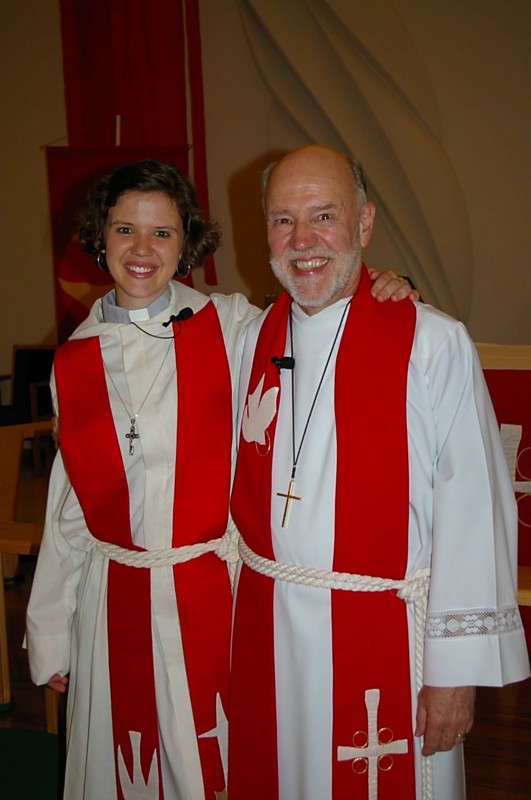
            Five years ago today, I was ordained into the ministry of Word and Sacrament. It happened in the church I grew up in, where my dad was pastor for nearly 30 years. My mom’s brother Daniel, also a pastor, was there as well – he was the assisting minister for the service – and he wore the red stole that belonged to my Grandpa Dick. The big moment in an ordination service is the laying on of hands, where all the ordained clergy gathered lay hands on this new ordinand while the congregation sings a song summoning the Holy Spirit, and the bishop says a prayer over this new pastor. My dad’s hands were there, and my uncle’s, and just beyond this sphere, my grandpa’s, and my two great-grandpas, also pastors, and my great-grandmother’s, who was a deaconess. A couple weeks ago we
"Surrounded by so great a cloud of witnesses..."
heard in Hebrews this wonderful verse, “Since we are surrounded by so great a cloud of witnesses, let us run with perseverance the race that is set before us…” It’s one of my favorites, and always makes me think of the cloud of witnesses that laid hands on me on my ordination day.
            Today in Hebrews, we hear another of my favorite verses: “Let mutual love continue.” Especially on this fifth anniversary of my ordination, I have been thinking a lot about what these words mean and look like, both in my life as an ordained person, and in my life as a baptized Christian. I think these four words state the hardest thing about being a Christian. In fact, I think the author of Hebrews is very optimistic to say, “Let mutual love continue” – it implies we already are doing it, and to keep up the good work! Well, I sometimes find loving others to be very easy – and what a joy it is when that happens! – but it is just as often very hard, indeed. Living a life of mutual love is certainly the most challenging aspect of life as a Christian, even as it is also the most rewarding.
What makes it so hard? Well, let’s ask it this way: what is required to “let mutual love continue”? I think a big part of it is one of the major themes in our Gospel reading today, and that is humility. In the Gospel story, Jesus advises not to assume you deserve the highest seat, but rather, sit at the lowest seat and wait to be asked to move up. It’s sort of simplistic advice to our modern ears, and taken literally it isn’t very often applicable to our lives like it would have been to the original audience. But thinking of it more broadly in terms of our relationships with others, especially our Christian, mutually loving relationships with others, it becomes much more poignant and convicting.
Now, it wouldn’t be convicting, if living in Christian community were all rainbows and sunshine all the time. But the thing about living in Christian community is that it is an awful lot like living in a family – and we all know that families, well… don’t always get along. People disagree, or get annoyed with one another, or disappoint each other, or don’t meet each other’s expectations. When that happens, when conflict erupts, fighting often follows, and it is in those moments that Jesus’ advice about humility becomes very difficult to hear. Think, if you are gearing up to fight, whether you fight with actions or with words, what is good strategy? Generally, you want to find yourself in the more powerful position, right? Even animals do this – the hair on their back goes up,
This is how big my Dachshund thinks he is.
or their feathers fluff, or their tails wag high and fast. Just ask my Dachshund: twelve pounds, and he thinks he’s the biggest dog in the neighborhood! We want to look and act bigger and more powerful than we are. We want to do the opposite of Jesus’ suggestion to “take the lowest place,” because that sort of humility is exactly what will cause you to lose the fight! So when faced with a conflict, we will be inclined to: insist our way is right, disregard others’ opinions and perspectives while we puff up and applaud our own, put others down, resist admitting to being wrong, whatever we need to do in order to stay in that higher, more powerful position, and be sure that we win the fight.
Humility won’t help that effort at all. No, humility has no place in winning a fight.
But remember, we are not talking about winning a fight. We are talking about living in community, and letting mutual love continue in that community. With that as our goal, we can’t look for a winner, because if there is a winner there is also a loser, and having winners and losers is not the way to remain in community with one another. That is not the way to let mutual love continue.
This is where humility comes in. What if, instead of trying to get to that highest seat at the banquet, we took Jesus’ advice, and sat in a lower seat? What if we listened to the concerns of the other, to what is true for them, and even “tried on” their ideas before disregarding their perspective? What if instead of looking for points about which to say, “You’re wrong!” we looked for ways to say, “I agree with you on that”? What if we made the effort to consider where our own perspectives might not encompass the whole truth? What if we asked for forgiveness when we realize we were wrong?
Suddenly Jesus’ advice isn’t nearly so simplistic. Suddenly it is very challenging. It is not just swallowing our pride and waiting to be invited up to a higher seat, it is actively working at loving someone, at honoring them and their opinions, at viewing them not as a stranger or outsider or enemy, but as an angel whom God placed in your path to show you something about what it means, what it takes, what it and looks like to live in a mutually loving community. Have you had people in your life fulfill that role? I know I have.
And that brings me to the second thing that is necessary if we want to “let mutual love continue.” GRACE. Certainly, it is grace for ourselves, because putting ourselves in such a humble position is very vulnerable, very dangerous. You could very well be trampled, especially if both parties don’t agree to be similarly humble with each other. And because we are animals, we often resort to those basic animal “fight or flight” instincts, and we don’t behave like we intended, like God would have liked us to behave. We need to acknowledge that reality, and trust that God will forgive us for those times.
We also must have grace for the other, because it is just as hard for them: we are all humans, after all, and we all make mistakes, we all fall short of the glory of God, we all are captive to sin and cannot free ourselves, no matter how hard we try.
But above all, what is required to “let mutual love continue,” is the very grace of God. And this has been, for these past five years of ordained ministry, my most frequent thanksgiving: that in all the ways I fall short of this strange and wondrous calling, all the missteps I take, all the times I didn’t live up to expectations of God, myself, or others – I still walk in the grace of God. Jesus still died for me, for this sinner. Jesus still defeated fear and death for me. Jesus still claimed me in baptism, 33
years ago today. I still come to worship and get to hear someone say, as they hand me that sacred meal, “The body of Christ, given for you.” For me! For you! God’s grace is given for us!
And with this, God’s amazing grace, I believe that we can let mutual love continue. It still won’t be easy, and it still might be messy at times, and it still requires the hard work of humility and vulnerability and loving honesty, with ourselves and with each other. But we can do it, because God’s grace makes it possible. As we continue down this road of ministry, whether it is ordained or lay ministry, that grace of God is all that keeps us afloat. Let us cling to that gift with all that we have and all that we are.

Let us pray… Gracious God, you call us to let mutual love continue, and to be humble in our relationships with others. This is hard work, God! But we give you thanks that you have entrusted this task to us, even as you have given us the grace to work at it. In the name of the Father and the Son and the Holy Spirit. Amen.

Sunday, August 28, 2016

Ministry anniversaries: baptism and ordination!

Today I celebrated the fifth anniversary of my ordination, and the 33rd anniversary of my baptism (yes, same day!). I wrote the following for our church newsletter in honor of the occasion.

“But we have this treasure in clay jars…” (2 Cor. 4:7)

            On August 28, 2016, I celebrated (with all of you!) the fifth anniversary of my ordination. This day is extra special to me, because on it I also celebrated the 33rd anniversary of my baptism! The significance of this correlation is not lost of me; I have always found it immensely meaningful. And so, on this fifth anniversary of this event, I wanted to reflect a bit on that with you.
Me with Pastor Dad
            My dad preached at my ordination – one of the special gifts of having a pastor dad! He has preached the gospel to me my whole life, and it seemed only right that he would do so on this special day as well. The sermon focused especially on the epistle lesson for the day: Paul’s metaphor of God’s people as clay jars. After describing the beauty of the gospel in which God shines light into the darkness through Jesus Christ, Paul adds, “But we have this treasure in clay jars, so that it may be made clear that this extraordinary power belongs to God and does not come from us.” There was one moment in particular from that sermon that still sticks with me, drawing on a line just before this metaphor: “’We do not lose heart,’” Pastor Johnson said. “Yes, I’m here to tell you that’s a part of the challenge. [Paul] goes on to recite some of the realities of ministry—and really, the realities of the Christian life: affliction, perplexity, persecution. That’s what Johanna has signed up for, you know. She signed up for a life that sometimes makes one lose heart.” As he spoke these words, I could feel a pit in my stomach. Dad, what you are doing? I thought. This is supposed to be a joyous day! Why are you freaking me out? I thought about the moving truck already making its way across the country with all my earthly belongings, and the two churches in western New York who had called this wet-behind-the-ears young woman to lead them, and started to wonder if maybe this was all a mistake.
            But then he went on. “Yes, that’s what she signed up for—twenty-eight years ago, when she was baptized!” And a larger picture became beautifully clear. He was right: my call to ministry had come long before what I told my candidacy committee (which was that I had received said call while serving as a missionary in Slovakia). It came that Sunday morning at Clovis United Methodist
Baptism day, Grandpa Dick, Mom, Dad, and baby Johanna
Church, on August 28, 1983, on which my Grandpa Dick poured water over my head and said I was baptized in the name of the Father, and the Son, and the Holy Spirit – that moment in which I was named and claimed by God as God’s daughter, in which I was given the gifts for ministry. It was not until 20-some years later that I realized those gifts for ministry included the gifts for the particular ministry of Word and Sacrament.
            I have held onto that these five years of serving as your pastor. I have held onto the deeply held belief that each of us is immensely gifted for different sorts of ministry, each so important. I have held onto the knowledge that pastors are not “set above” anyone else, so much as “set apart” for the particular ministry to which they are called. And I have been grateful to see the ways you bunch of baptized ministers have shown me this truth over and over.
            Perhaps most of all, I have held onto it each time I am reminded of my clay pot-ness: the brokenness and vulnerability that I share with every other human being on earth. Another quote from that ordination sermon: “[Being a clay pot] means, of course, that we human beings are weak and frail, subject to being broken, chipped, cracked. We aren’t even called ‘fine china’—just earthen vessels, nothing too attractive, nothing too special, just ordinary people with ordinary talents and ordinary longings and ordinary pains and troubles. That doesn’t change when you are ordained. We are, all of us, clay pots.”
            As a pastor stands to make her ordination vows, she offers the same answer to each of four questions: “I will, and I ask God to help me.” This has been my prayer each day I have served you: God, help me fulfill the hopes and expectations of this strange and wondrous calling. God, help me be the servant you have equipped. God, help me to love when it is hard to love, help me to hear your Word when the sounds of the world are so loud, help me to see Christ in all people. I will do my best to fulfill this calling, and I ask you, God, to help me.”

"I will and I ask God to help me."
            May this be the prayer of every minister of God, every baptized believer, every called member of the Body of Christ. I know it will continue to be mine, as I walk further along this remarkable road of ordained ministry. Thank you for accompanying me this far, and thank God for you!

                                                                                    God’s baptized child,


                                                                                    Pastor Johanna

Tuesday, August 23, 2016

Sermon: Freedom with head lifted high (Aug 21, 2016)

Pentecost 14C
August, 21, 2016
Luke 13:10-17
  
Imagine this: you’re in church, listening to a sermon. You always come to church on Sunday, because God tells you to, in the 10 commandments. Remember the Sabbath, to keep in holy. Also because you like to come and see your friends, and to worship God, and to be filled up for the week, yes, but you also get a certain satisfaction in knowing that this commandment, about the Sabbath, you’re doing your part to keep.
So the sermon is getting going, getting to the part where you squirm a little in your seat, and you think, “Oh yeah, I needed to hear this this week. This speaks right to a situation I’m dealing with right now.” And suddenly, the preacher stops, and starts walking down the aisle. You turn around to see he’s walking to meet a strange woman who has just walked in. She’s sort of bent over, maybe osteoporosis. You overhear the pastor talking to the woman, as she explains she’s had this condition quite a few years now. The pastor decides now is the time to go find a phone number for a good doctor, to help this lady out.
You feel for her, you really do, but man! The sermon was just getting to the good part, the part you needed to hear! You can’t help but feel a bit annoyed. This lady has been dealing with this thing a long time already. Maybe she could just have waited it out until the end of worship and dealt with it then? (There was even communion that day, which you love and really needed today!) Why did she have to interrupt worship? Apparently the council president feels the same way, and she stands up to say something about it: “Can’t this wait until we’re done? There are 23 other hours in the day to get help!” You secretly agree with her. And the pastor says, “This woman is a child of God, who is in need right now, and has been for a long time. Isn’t during worship the perfect time to set her free
from this bondage she has endured?”
Does the pastor have a point? In the first century version of this story that we just heard, the crowd thought so! When Jesus stands up to the leader of the synagogue’s insistence that this is the Sabbath and certain things shouldn’t be done on the Sabbath, Luke tells us that the crowd gathered was delighted! Rejoicing at what he was doing!
The story of the bent over woman: an unassuming woman who probably was just going to synagogue like she had many times before, probably a devout woman seeking to experience God that day. Being so bent over, she likely didn’t see much of the world – if you imagine her posture, what do you think she saw most of? Her own belly button! But she trudged to synagogue each week, as the commandments told her. And on this particular day, she experienced an encounter with God she had not anticipated!
Keeping the Sabbath is such a fascinating commandment. So many of the commandments appear to be for others’ benefit – don’t steal, don’t murder, don’t lie. Even the first couple: “put God first, don’t have idols.” But the Sabbath is something different. Let’s consider this a moment. First, a little quiz: do you remember what is the rationale behind keeping the Sabbath? [God rested on the 7th day.] Right, God did it, so we should too. It’s a day of rest, a day we don’t work. That’s what Genesis and Exodus tell us. BUT, for a bonus point: the commandments also appear in Deuteronomy. Do you remember what the rationale is there? The explanation there says, “Remember that you were a slave in the land of Egypt, and the Lord your God brought you out of there with a mighty hand and an outstretched arm; therefore the Lord your God commanded you to keep the Sabbath day.” Here, the Sabbath isn’t so much about rest as it is about redemption, about freedom. “Remember that I am the God who frees you from what holds you captive,” God says, and implied then is, “On the Sabbath, use this time to remember how I free you.”
I bet “free” is one word that bent over woman would use to describe how she felt that morning! 18 years she had dealt with this condition, 18 years of being so bent over she couldn’t see anything but her own navel, 18 years she could barely participate in society because she couldn’t even walk straight. This past week, my mom had eye surgery to correct something that has obstructed her vision for several months, maybe more. On Wednesday was the moment of truth: she got the eye patch off to see if it worked. On Facebook appeared the exuberant post in all caps: “I CAN SEE!! WHEEEE!!!” She dealt with a condition not nearly so debilitating, and for much less time, but the recognition of it being fixed was such a relief, such a sense of freedom! Just imagine how this bent over woman felt!
Some of us deal or have dealt with such debilitating illnesses as the bent over woman, some currently are. But even those of us who mercifully haven’t, the sentiment is still applicable. So many things hold us captive, not just illnesses. So many things, even, cause us to feel bent over, physically
or emotionally. For example, if you have a horrible stomach cramp, what do you do? You bend over. Pain in heart or body makes us bend over. If you’re standing near a soccer field and you hear, “Watch out!” what do you do? Duck and cover your head. Feeling unsafe makes us bend over. If you are overwhelmed by life and can’t bear one more thing, what do you do? If you’re like me, you curl up in the fetal position on the couch or in bed and cover your head with a blanket! We bend over! We bend over to protect ourselves from the struggles of the world.
But when we do this, we have the same problem as the bent over woman in Luke: we can’t see. Sometimes, when we can only see ourselves, we find it difficult to look outside ourselves for help. Martin Luther has a wonderful phrase for this: incurvatus in se. It’s Latin for “curved in on yourself,” and it’s his definition for sin. When we are curved in on ourselves, we see only our needs, our wants, our perspectives. We are slaves to these things, and so neglect the needs and the offerings of what is outside of ourselves – our neighbors, and of course, God.
Grace, my daughter, is almost one year old now (!), and it has been so fun to watch her learn to walk. She’s so close! At first, we showed her how to stand by holding onto something. She would stand there with her head hanging, looking down at her feet, unsure about this new posture. Eventually, she would just crumble into a seated position and crawl around instead. Now, she looks up. Holding her head up high, she looks around for what she wants or needs, and uses her feet and our furniture to get to it, laughing all the way. With her head up, she is full of delight and rejoicing. The next step, of course (no pun intended), is to walk without the aid of furniture. At this point, she stands and we hold our arms out inviting her over. She looks at those hands, keeps her eye on what will keep her safe. She’s yet to jump out of the nest, though. Sometimes she gets scared and curls in on herself again, crumbling into a seated position. But sometime soon, she will trust those arms
Grace, enjoying her erect freedom
reaching out to her, and go to them.
Jesus holds these arms out to us. Jesus sees us, even when we don’t see him, when our heads are too bent down from our suffering, our pain, our captivity, too bent down to see him offering his healing, love and grace. Jesus sees us, and Jesus reaches out to us, offering us the very essence of the Sabbath: the knowledge that God frees us from sin, frees us from captivity, frees us from all that would keep us bound.
And an amazing thing happens when we are free, when our heads are lifted and our backs straightened out: suddenly, we can see the world around us through the eyes of our freedom. Thinking again of my little Grace: her raised head and the resulting mobility has allowed her to experience the world in a more profound way. The other day I was so upset, I came home and sat on the couch weeping, head in hands. I was bent over in pain and sadness. Grace toddled over to me carefully, holding the furniture, and gently touched me. I looked at her and she grinned at me and said something in her baby language, and engaged me in a game. Suddenly, my head was up, and I was laughing. This small human, with her head held high, was able to extend the most basic form of empathy, of compassion, to someone in need. When she wasn’t captive to her hands and knees and her hanging head, she could reach out to love and serve.
This is the amazing thing about the freedom the Sabbath offers us, the freedom the gospel offers us, the freedom that God through Christ offers us. No longer bound by our ailments, we can lift up our heads, look around the world, and be the servants that God has called us to be, loving and serving the world. Thanks be to God.

Let us pray… Redeeming God, the weight of the world causes us to spend too much time bent over, stuck in our own navels. Thank you for seeing us, for lifting us up, for showing us the freedom you offer, so that we might share that freedom with others. In the name of the Father and the Son and the Holy Spirit. Amen.